

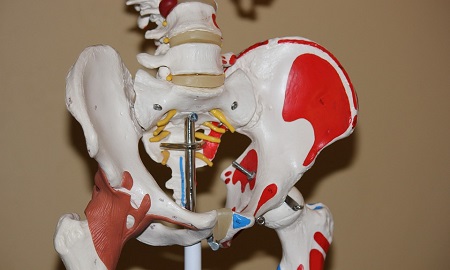
The hip joint consists of a ‘ball and socket’ mechanism and it normally moves freely through a wide range of movements, but a problem that can interfere with this free motion is known as Hip impingement or FAI (Femoroacetabular Impingement).
What are the symptoms of FAI?
The symptoms of FAI are hip and joint pain with limited mobility.
- It can start suddenly as an injury, or gradually build up during various activities
- There is usually a restriction when turning the leg in, or pulling the knee to the chest
- Pain can be provoked or exacerbated trough long periods of sitting, crossing the legs, walking, or during or after sports and general exercise
- It is usually experienced as deep groin pain at the front of the hip, but can occasionally be felt on the side of the hip or the buttock.
What are the causes of FAI?
The 2 main causes of Hip impingement are:
- A deformity of the socket of the hip joint (Pincer deformity) – in which the front rim of the socket protrudes enough for the ball to bump into the socket’s rim during movement.
- A deformity of the ball of the hip joint (Cam deformity) – in which the ball can become misshaped and jam into the socket during movement.
Occasionally there are problems with both ball and socket, known as a combined deformity, but this is not as common.
What is my best course of action?
X-rays of the pelvis and the hips are usually undertaken to confirm the diagnosis of FAI. An MRI or CT scan can also possibly be required. The pain is generally self-limiting and non-operative treatment is usually recommended.
It is especially important to note that these bone shapes may be a result of a person’s habitual movements and lacking stability around the joint (rather than assuming that its congenital), so rehabilitation alone can address the cause where biomechanics are to blame and operating in such a case may bring initial relief, but would not have addressed the cause of the symptoms and so the condition is likely to re-develop.
Your Physiotherapist can assist FAI by using a variety of techniques which will: mobilise the hip joint to stretch tight structures; strengthen deep, intermediate and superficial hip muscles to improve joint control; improve the length and flexibility of soft tissue; improve proprioception (Joint position sense), functional control and dynamic stability of the hip …and the rest of the body, as it is all connected and should function as a unit in the end!
The use of painkillers and anti-inflammatory drugs may help reduce pain and inflammation, but should not be used as a long-term management as neither of these will address the underlying issues. Contact us for a comprehensive assessment and to begin an individualised, structured rehabilitation program and only if that fails, despite your full commitment to the task, would we recommend you obtain a surgical opinion.