

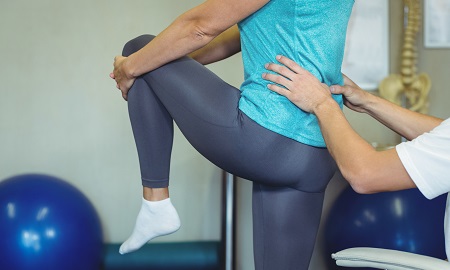
The Sacroiliac joints (SIJ) are formed by your pelvic bones joining onto either side of the sacrum bone, at the lower end of the spine. When any abnormal increase or decrease of movement at the joints take place, this may lead to Sacroiliac pain, which is known as Sacroiliac Joint Dysfunction (SID). It is therefore vital to have normal movement and good muscle control in this area to maintain happy joints.
What are the symptoms of SID?
- Lower back, hip, buttock and sciatic-type pain are all symptoms of SID, as with many other lower back and hip conditions.
- Sacroiliac pain can be aggravated by many movements, particularly that of standing up or sitting down, and by bending forward or climbing stairs or hills.
- Pain is usually only on the one side but there may be dysfunction on both sides.
What causes SID?
The normal movement of the Sacroiliac joint is just a few degrees, so when that movement is problematic they rely, as most joints do, on stabilisation from the surrounding muscles. In the case of the SIJ, the key stabilisers are the deep abdominal core and deep gluteal muscles. It’s important that these muscles work in sync and have enough endurance to support the lower back and pelvis for prolonged times.
Whenever these muscle groups are weakened or lacking in endurance, it can lead to excessive movement of the SIJ, which in turn leads to SIJ ‘hyper-mobility’ dysfunction, which can cause SIJ pain.
What is my best course of action?
To save time and money, contact your Physiotherapist directly who, with expertise and experience in musculoskeletal conditions, will perform a thorough physical examination to assess the extent of your Sacroiliac joint pain or dysfunction. X-rays are of little benefit in the diagnosis of SID, but in non-responsive conditions, an MRI may be suggested to rule out other possible reasons for the pain.
Having confirmed SID, your Physiotherapist will initially work on pain relief and may deploy electrotherapy, dry needling, deloading tape techniques, an SIJ belt and soft tissue release, amongst others, dependant on what is necessary. This will then be accompanied by an abdominal and hip core stability program to restore normal strength and prevent the condition from re-occurring. Contact us ASAP to get you back on the path to a normal pain free existence!