

Your child has been complaining about his knee for the last couple of months and in trying to get to the bottom of it you may have been told to let him just push through – “it will pass!” Or he must “stop all sports immediately!” Should you take him for a cortisone injection? Will it ever recover? How long does it take? “Can I do more to help than giving him pain medication?”
At the end of this article I hope to have given you a better understanding of the causes, aggravating factors and the treatment options you can consider along the way.
Osgood-Schlatter disease commonly affects children/adolescents around the start of puberty as their growth is accelerated and their involvement in sports increases. The muscles and tendons are typically unable to keep up with the rapid lengthening of the femur (thigh bone) and start taking strain at the attachment point on the shin, below the knee cap. In the absence of frequent running/jumping-type activities the tendon has a chance to adapt before symptoms really become apparent and symptoms should also be significantly less in children who have been at a set level of activity throughout childhood whereby eliminating the sudden increase in activity towards early teens and which would have provided the tendon with a strong base leading up to any growth spurt.
The resultant tendon (and sometimes bone) damage presents as varied levels of pain and swelling in the area and is temporarily aggravated during and after activity which caused pulling/strain through the tendon but could also become constant in more severe cases. The duration and intensity of the pain will be influenced by the management of the condition and the duration of each growth spurt – which means that it may very well recur if then tendon hasn’t been sufficiently strengthened before the next spurt.
“When do I need to get professional help?”
I have a few rules of thumb for this type of question:
- Is your current management allowing your child to continue with/resume normal activities/sports?
- Or are you at least seeing frequent improvements?
While the condition should resolve once the growth spurt has passed, this doesn’t provide any relief while your child is in pain and halfway through his soccer season and in no way stops this from recurring at a later stage.
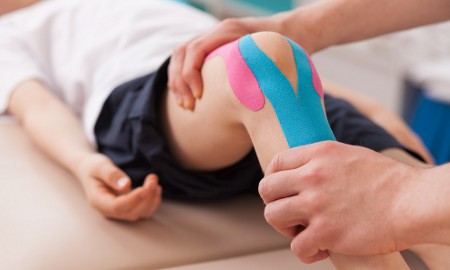
A Physiotherapist is able to make a clinical diagnosis following a comprehensive assessment and will approach this condition from multiple sides simultaneously to address some of the causes and minimize – if not resolve – the pain in the meantime.
- We need to limit the progression through RELATIVE REST while allowing the tendon to continue strengthening further and become more robust for the next spurt.
- We need to minimize the pain and swelling to restore pain-free mobility as far as possible, as soon as possible.
- We need to rehabilitate the leg in general to ensure that the biomechanics are restored and to allow your child to put the whole ordeal behind him!
How should you go about getting Physiotherapy for your child?
You need not visit a doctor or specialist before attending physiotherapy in South Africa (unless your medical aid insists on it) as Physiotherapists are “First line practitioners” and are trained to not only diagnose conditions within their scope of practice but also identify additional conditions allowing them to refer you to the appropriate practitioner should physiotherapy not be indicated for whatever reason or if we need to have x-rays done to gain additional insight beyond that of the clinical tests.
If you have more questions which aren’t answered in this article, you may get in touch and we’ll gladly assist!
You may contact us via email, text or calling to either book an appointment should our location be convenient or we can put you in touch with someone in your area if that’s needed.