

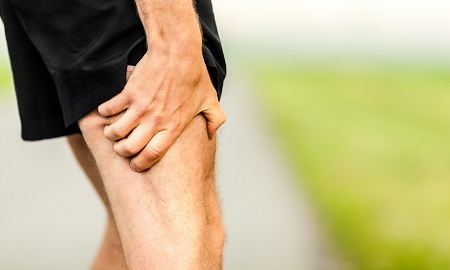
If you’ve ever felt sharp or burning pain on the outside of your knee or thigh, especially during running or cycling, you might have been told it’s an iliotibial band (ITB) problem. The ITB is a dense tendon that stabilizes both the hip and the knee. When it acts up, should you listen to your colleague and rest it? Should you listen to your training buddy and abuse it with a massage gun? But before assuming what causes the pain or how to fix it, we need to look more closely.
Why ITB-type Pain Isn’t Always Tendon Load Related
- Tendon overload causes tendinopathy: Pain from a tendon’s inability to cope with load. This occurs with either excessive load on a healthy tendon or normal load on a compromised tendon.
- Lower back referral is common: A pinched nerve easily causes isolated thigh/knee pain through misleading signals. It’s more likely than tendon pathology even in the absence of lower back pain.
- Hip mobility and health: Limited hip motion or joint health can refer pain to the same area, even without hip pain.
- Knee mobility and joint: Pain in the thigh is not explained by knee joint pathology, so assessing the knee is unlikely to be helpful. Pain at the knee may justify assessment for the rare possibility of two separate conditions.
- Muscle weakness and muscle overuse may contribute to pain but are not legitimate diagnoses for persistent or recurrent symptoms, despite common use. Identifying the true drivers is essential for full understanding and management.
- Pain processing errors result in false alarms in the absence of tissue danger or damage. Symptoms would typically be more widespread than thigh and knee alone but may still play a role.
- Uncommon but important causes include infections, bone diseases, stress fractures and autoimmune conditions.
- Differentiating between the commonly assumed overuse / weakness and the real-world possibilities noted above, require careful analysis of training habits, symptom patterns, and how joint movement affects symptoms in the moment.
Why Foam Rolling, Massage, And Rest Are Frustratingly Worthless
- When the tendon is the source:
- Tendon, not muscle: The ITB is not a muscle. It can’t contract or forced to relax. In fact, tendons respond poorly to compression and are likely to retaliate. Tendinopathies need correct loading to build capacity, and counterintuitive as it sounds, this rehab requires some pain. No alternative restores lasting function.
- Rest deconditions: Given the above, rest moves us in the wrong direction. While significant pain may suggest rest, effective ways exist to begin reconditioning without leaving pain unchecked. Work with a knowledgeable professional to guide the process.
- When the tendon isn’t the root cause:
- If it’s a nerve, joint, disease or processing error responsible for the pain, addressing these directly yields better results than rest, “TLC,” or aggressive treatment.
Where to from here? A Full Assessment
Because the causes vary so widely, a full assessment is essential. A professional will consider:
- Is the ITB actually the pain generator, or is it perhaps a nerve?
- Is hip mobility limiting or affecting load distribution?
- Is the nervous system triggering a false alarm?
- Are there signs of a medical cause where referral to a doctor is needed?
Once the true cause is understood, we can act:
- If it’s a tendon, we lessen pain and load it!
- If it’s a nerve or joint, we remove obstructions and restore normal mobility.
- If it’s processing errors, we retrain it.
- If its outside of the scope of physiotherapy, we refer you to the correct profession
The right diagnosis means the right treatment and that’s what gets you back to your sport, stronger and safer.
Your health and wellbeing deserve informed, personalised care. For tailored support, please discuss any questions or concerns with your physiotherapist of choice.