

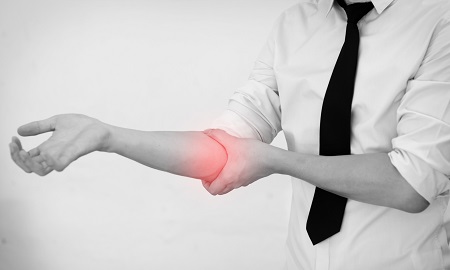
The best way to explain what Golfer’s elbow and Tennis elbow is, while noting the similarities and differences between them, is to do a comparison of the two. They are very similar but occur on opposite sides of the elbow joint.
Golfer’s elbow involves an injury or irritation to the muscles which are responsible for closing the hand and bending the wrist forwards. This condition results in tenderness on the inside of the elbow joint and may even progress to a bony bump forming at the muscles’ attachment site.
Tennis elbow involves an injury or irritation to the muscles responsible for opening the hand, or bending the wrist backwards. This results in tenderness on the outside of the elbow joint and may also progress to a bony bump forming at the attachment site of these muscles.
Contrary to what many believe, neither Golfer’s elbow nor Tennis elbow involves increased inflammation! Therefore, solving the problem does not require a reduction in blood flow or inflammation – it’s in fact quite the opposite.
What are the symptoms of Golfer’s and Tennis elbow?
Depending on which condition you’re suffering from, the reproducing and stretching movements will differ and the nerve involvement and location on the elbow will be opposite, but in both cases:
- Pain is experienced with movements of the hand and wrist which result in stretching or contracting of the affected muscles (especially so if against resistance). This includes grasping objects.
- Tenderness is experienced with touching a trigger point and/or the attachment site of the affected muscles.
- Neck stiffness along with nerve irritation may be present.
- Contrary to popular assumption, elbow joint movements are typically 100% pain-free.
What causes Golfer’s and Tennis elbow?
Golfer’s elbow and Tennis elbow occur when normal healthy tissue can’t handle the excessive force required of them. Simply put, a sudden increase in activity in these muscles increases the demand placed on them beyond that of their fitness. Should nerve irritation result in a sudden increase in muscle activity, the demand also increases, which again may exceed the ability of the muscles. It could also be due to one of the muscles in the group suffering a traumatic injury, leaving the normal work load to the remaining muscles.
Degeneration of the integrity of the tendinous attachment site typically occurs when there is a reduction in activity in the muscles (usually to rest these injuries), whereby the body’s response is to break down the fibres which are no longer needed. Naturally, if the activity levels return to normal thereafter (following the rest period), the (now degenerated attachment fibers) will fail even quicker than before and the automatic assumption is that additional rest is needed – this leads to further degeneration – a nasty, snowball effect. This is why it is important to know what is causing the pain and to take the correct action as soon as possible.
What is my best course of action?
Consult your Physiotherapist directly – where clinical tests will be used to determine the extent of your condition and if need be, you can be referred for investigations/imaging.
Treatment is typically aimed at relieving pain, restoring mobility and most importantly, the strengthening of weak muscles to ultimately correct one’s biomechanics. Depending on the individual findings, there may be a benefit in using muscle stretches, massage and strengthening, electrotherapy, protective strapping, neck, neural and fascial mobilisations. Should the condition be especially tender and not adequately responsive after a single treatment, your Physiotherapist may suggest wearing a wrist brace to limit the amount of work done by the affected muscles. The braces used around the elbow joint may only improve one’s symptoms in the short run and the same effect can be attained from strapping, which is significantly more comfortable. Please contact us should you wish to discuss what treatment options may be best suited to you