

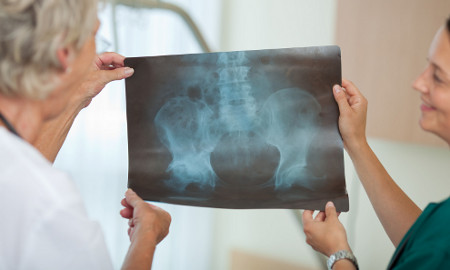
People experience hip pain at different times and for different reasons. Most commonly, you fear that there is something wrong with the actual joint which could mean years of trouble or future operations which nobody wants! The first suggestion I make is to look at the location of the pain. Hip JOINT pain is usually experienced in the front, next to the groin. If your pain is more towards the side, its likely to be something other than the joint.
Very commonly, I see patients who are experiencing pain on the side or the back of the hip and the source is either the lower back or in the muscles surrounding the hip. You may even have evidence on x-ray suggesting joint damage or disease while the source of YOUR pain is still not the joint! Listen to your pain and assess the location. In the end, if your physiotherapist and your doctor are both unable to diagnose and successfully relieve your pain, a local anaesthetic can be injected into the hip joint to determine if the pain is located within the joint or not. But just for now, especially if your pain is not in your groin, forget about the films, scans and injections!
Your first step when you are feeling pain in the hip area should be to have your physiotherapist assess the quality of movement, the aggravating and easing factors and the history leading up to the point where you started feeling the pain. We will look at the entire picture rather than basing our opinion on just an x-ray. Once we have established a diagnosis, the treatment is targeted at allowing healing, restoring good quality movement and rehabilitating all the involved structures to avoid a recurrence of the problem. Be mindful that any single one of the possible conditions which may be causing your pain, could have local and more distal causes or influences. We will still look at the way your back, knees or feet may be impacting on the hip condition, no matter what your diagnosis.
The exercises are at times difficult and once your pain has been relieved, rehab is often the last thing on your priority list! However, your dedication to your rehabilitation programme, will ultimately determine how often you need to do damage control for a recurrence of the same pain.
I’ll divide the possible pathologies you may be faced with into the types of structures involved. Firstly, we’ll look at the soft-tissue and then at the bones, cartilage and ligaments.
Pain from the surrounding soft tissue can range from a continuous, dull ache to a sharp, shooting pain, typically when you put weight onto the leg. It’s no wonder that people often think its the joint.
Pain originating from the joint often occurs following trauma but it may be a developmental problem or even as a result from your recent cortisone injection!
If you’ve had a look at the two links above and you’re still no closer to finding the source of your pain, we welcome you to contact us. No two conditions are alike and your distinguishing symptom may not be mentioned in these summaries. We are happy to help even if you aren’t sure if physiotherapy is what you actually need.