

The Labrum is a ring of cartilage that follows the outside rim of the socket of the hip joint. In addition to cushioning the hip joint, it acts like a rubber seal to hold the ball at the top of your thigh bone within your hip socket. When part of that cartilage is torn from the socket it is known as a Hip labral tear.
Athletes participating in sports like soccer, rugby, golf and ballet are high risk candidates for these labral tears, because of the strain put on the Labrum by all the twisting over the hip. Structural abnormalities of the hip can however also play a role in increasing the likelihood.
What are the symptoms of a Hip Labral tear?
Not always, but in most cases, pain or an ache is felt over the lateral hip area, in the groin, or in the deep buttock region. One can at times also feel a ‘clicking’ as the hip socket is moved, and the perception is of it locking or giving way.
The symptoms may be worse when sitting with your knees below your hips, with crossed legs (when the hip is rotated) …or on the edge of a seat so that you are contracting the muscles that flex the hips.
What are the causes of Hip labral tears?
There are 3 primary causes of Hip labral tear:
- Structural abnormalities – Hip problems from birth can promote wear and tear of the joint and ultimately result in a Labral tear.
- Repetitive motion – Sudden twisting or pivoting motions practiced on a regular basis, as with the aforementioned sports or other daily activities, through pure wear and tear of the hip joint.
- Trauma – Injury or a dislocation of the hip joint, as in contact sports or an accident can also be a cause.
What is my best course of action?
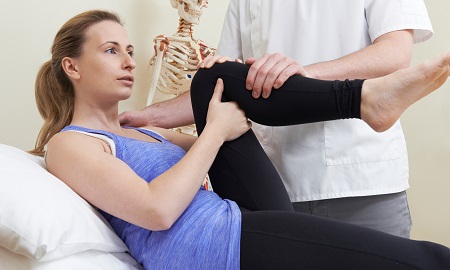
Your Physiotherapist can be contacted directly and will embark on an assessment to form a clinical diagnosis based on your symptoms and clinical signs, like restricted movement. An MRI may well be recommended, as it is difficult to get a specific diagnosis without it.
With or without any definite diagnosis, treatment would start by avoiding aggravating activities and building the stability that may be lacking in the joint. The focus will be on restoring flexibility and strength through: assessing your biomechanics and muscle function; restoring limited range of motion and improving soft tissue muscle length and resting tension; strengthening superficial muscles and activating deep stability muscles in addition to augmenting joint position sense and proprioception – all the while, ensuring that you trust your hip’s ability to resume normal function. Without trust, even a perfect joint is worthless!
After making these significant improvements in functionality, your Physiotherapist will: improve functional activities through a series of daily exercises; do drills to improve agility and speed and recommend a suitable modified and monitored sports program.
Not all Hip labral tears respond to conservative treatment, but if surgery is still required, this program will have put you at a great advantage for surgical consideration, so contact us now to embark on a treatment program to have you back in action or ready for optimal post-operative recovery ASAP!