

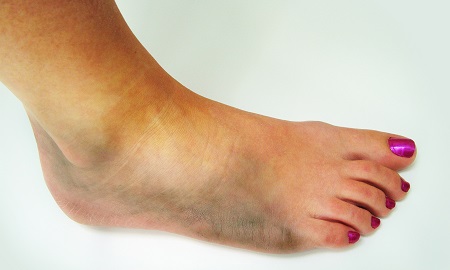
‘Ligament sprains’ and ‘Muscle strain’ are often confused and usually written about in tandem, however they are in fact quite different. Muscle and tendon (joining muscle to bone) strains occur when there is a poor level of fitness or poor dynamic control within the muscles, whereas Ligaments join bone to bone and injuries occur when there is excessive movement forced through a joint…quite different and so we deal with them in separate articles.
What is a ‘Ligament sprain’, as opposed to rupture?
To elaborate a little, ‘Ligament sprain’ occurs when its inelastic fibres are stretched through too great a range and tearing of the ligament takes place. The tear can be just a few fibres and classed as mild or grade I, but when classed as severe or grade III, a complete ‘rupture’ of the ligament has taken place, leading to joint instability.
How do ligament sprains happen?
The most common type of sprain is a sprained ankle, usually occurring amongst runners and sports people in general but it could happen to anyone. To give an example, in the USA alone, 25 000 ankle sprains occur daily. A runner going over a curb, catching the foot and twisting the ankle is a typical example. Knee and ankle sprains also happen in stopping and turning sports like hockey or soccer or in baseball where a player slides into the plate and twists the knee. The whipping arm action of the baseball pitcher and swing of the Golfer can also cause shoulder and elbow sprains and thumb, finger and wrist sprains happen in sports like skiing where one falls with an outstretched palm, or netball and cricket through catching injuries.
What are the symptoms of sprains?
Pain, inflammation and bruising are all common signs and symptoms of a sprain. At the time of injury, you may hear or feel a “pop” in your joint. With a mild ankle sprain, the pain may not be too intense and you may just have a limited ability to move the affected joint, but with a ruptured ankle ligament one may not be able to bear any weight on the foot.
What is my best course of action?
Mild sprains can sometimes be successfully managed at home with relative rest, compression and elevation but if the symptoms aren’t improving significantly each day over any 3 consecutive days, it’s likely that the management at that time is not sufficient. For your own peace of mind, to assure that the treatment is being correctly administered and to reduce the recovery time, it is advisable to consult a Physiotherapist directly to get started on the correct rehabilitation program, in addition to the management of your symptoms. It is essential to contact your Physiotherapist if you can’t walk more than a few steps, move the affected joint, or if you feel any numbness in the injured area. Severe sprains or ruptures may even require surgery, but you can save time and money if you contact us first, as Physiotherapists are the specialist for this type of injury, trained to have you back in action ASAP and refer immediately should that be required.