

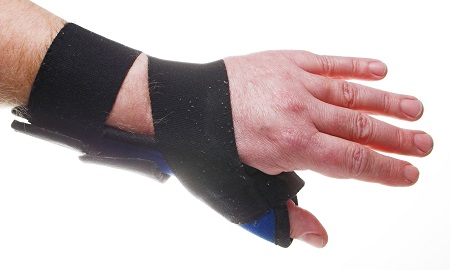
There are two thumb tendons, the Abductor Pollicis Longus (APL) and the Extensor Pollicis Brevis (EPB), that are involved in the onset of the condition known as ‘De Quervain’s Tenosynovitis.’ Travelling side by side along the inside of the wrist they pass through a Synovial tunnel on the thumb side which helps to keep them in place. They glide back and forth freely to move the thumb because of a slippery coating called ‘Tenosynovium’ and when this and/or the tendon become inflamed it results in Tenosynovitis and when that inflammation restricts the movement of the tendons in the tunnel, the diagnosis is ‘De Quervain’s Tenosynovitis.’
What causes De Quervain’s Tenosynovitis?
- Squeezing, pinching and grasping are all hand and thumb motions that, when repeated too often, can lead to Tenosynovitis inflammation. So, it is generally overuse and poor hand postures that are the main causes.
- Holding the hand at right angles to the wrist can also rub the tendon.
- Old scar tissue can encumber the tendon fluidity and Arthritic diseases, like Rheumatoid Arthritis, can also be the cause.
How do I know I have De Quervain’s Tenosynovitis?
You may well have De Quervain’s Tenosynovitis if you experience any of these symptoms:
- Grasping things with the thumb and hand becomes increasingly painful
- Pain in the forearm on the thumb side by the wrist
- Pain spreading up the forearm or down into the wrist and thumb
- You hear a type of ‘creaking’ noise (Known as Crepitus) as the tendons move through the blocked tunnel.
What is my best course of action?
It is best to see your physiotherapist as soon as possible and you can save time and money by going directly to them. No extensive testing is required to accurately diagnose De Quervain’s Tenosynovitis. A test known as The ‘Finklestien test’ is usually used and is one of the best. You will be advised on what hand and wrist movements to rest and restrict or possibly to wear a ‘thumb-spica’ splint which stops the wrist and lower joints of the thumb moving, thereby allowing the APL and EPB tendons a chance to rest. Contact us for an accurate diagnosis and treatment that will get you back to normal as soon as possible.