

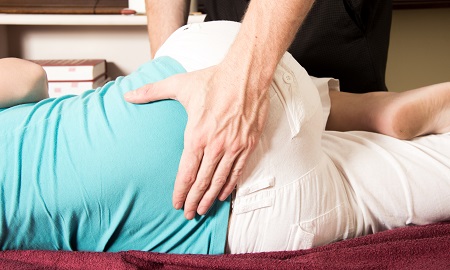
Spinal manipulation and mobilisation are associated but different in their application. Spinal manipulation is a high velocity but low amplitude passive thrust to the joint complex. Its intention is to reduce pain through restoration of the normal function and mobility of the spine. ‘Mobilisation’ comprises continuous passive movements to the joint complex. Different speeds and depths are used, aiming to achieve the same end result as manipulation.
What are the joints that are manipulated and some symptoms?
The ‘facet joint’ which sits behind the spinal canal is the main joint of the spine that is manipulated. Also manipulated is the intervertable segment in the ‘Cervical spine’ to influence the U-joint. The facet, the costo-vertebral and the costo-transverse joints are the three joints on the back of the ‘Thoracic spine’/Upper back.
Symptoms in the neck, arms and lower back can be a result of abnormal stiffness in the mid-back, which responds well to manipulation. The lower back or ‘Lumbar spine’ has the largest vertebrae, with facet joints aligned to protect the spine, which are usually less mobile than joints higher in the spine.
Between the large hipbone and the base of the spine is the ‘Sacro-iliac’ joint, very vulnerable in women, particularly during and after pregnancy, but good news for them is that manipulation of this joint can often give immediate relief.
Why should I see a Physiotherapist?
Many forms of musculoskeletal and particularly acute back pain are greatly relieved if not completely resolved with an effective spinal manipulation and/or mobilisation program. Your Physiotherapist, providing he/she has completed a post-graduate course on spinal manipulations, is trained to take the safety precautions of clinically testing for joint stability as well as nerve and artery function so that he/she can determine if spinal therapy is in fact a treatment option for you. The spinal joint may not always respond to the high velocity thrust of manipulation and your Physiotherapist will immediately ascertain if continued mobilisation and soft tissue therapy may be preferable to achieve improved mobility when the tissues around the joint, for example, have become very stiff. Remember, time and money can be saved by booking directly with your Physiotherapist, so contact us for an assessment and recommended treatment as soon as the symptoms of any musculoskeletal or spinal injuries arise.